THE UNBROKEN WORD

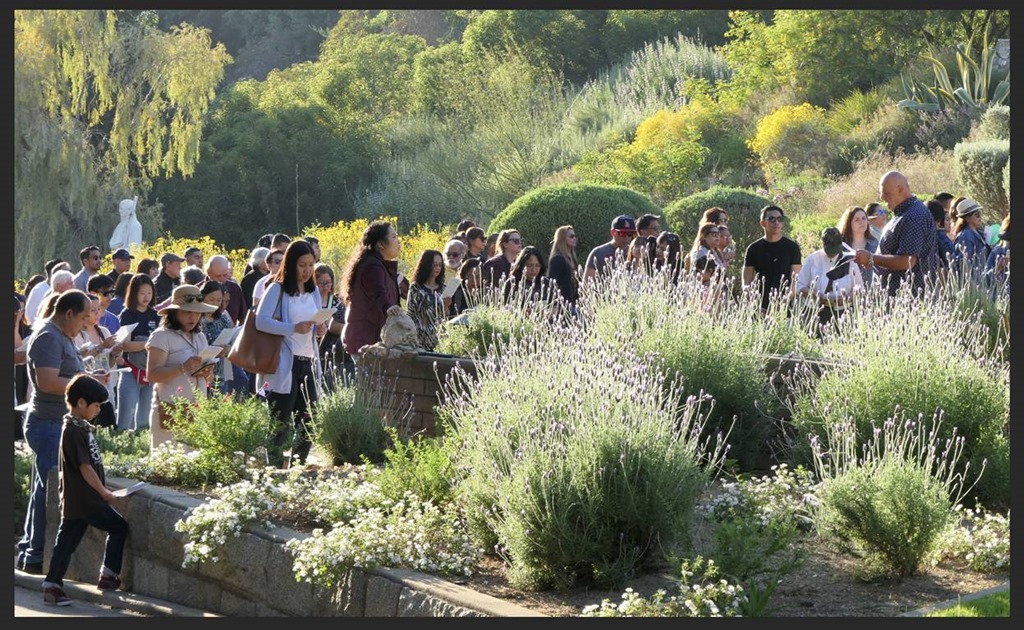
Every year on Good Friday, more than 3,200 people gather at the Mater Dolorosa Passionist Retreat Center in the San Gabriel mountains to pray the Stations of the Cross together. This pilgrimage is an annual event, with people from all over the southern California region attending.

As this was my first full year working at Mater Dolorosa, this was my first experience. The joy of being with and praying with so many who are dedicated to this prayer form is indeed inspiring. It is also interesting to see the differences in traditions each parish or national group brings to the day. By the evening, we had nearly all the stations at the center decorated with flowers of a wide variety.
clip_image002

It is surprising how much variety there is when praying the Stations of the Cross. The narrative can be very traditional in nature, or more modern and accessible.

Here is an excerpt from one of the many narratives we use at Mater Dolorosa for the Stations. This one written by the well-known theologian Dr. Michael Downey.

Leader: Before setting out on the Way of the Cross, let us gaze on Jesus in the Garden of Gethsemane as he surrenders to the Father’s will. (Pause)

Leader: In this lonely hour while others sleep, you come face to face with the Father in the deepest recesses of your heart at prayer. You ask the Father to relieve you of the horror that lies ahead, but in an act of surrender you lift your hands in prayer and give yourself over to the Father’s will.

This is a moment of anguish and soul-searing struggle. But it is also a moment of luminous glory. Because it is here that you glorify the Father by the act of complete self-surrender. And begin the Way of the Cross that leads to Calvary.

Response: Amen

We often relive the journeys of the life of Christ and the Holy Family with the various mysteries of the rosary, bringing us into imaginative prayer as we place ourselves alongside them in their times of joy and sorrow.

This oscillation of joy and sorrow helps us in our faith in a very special way. While is not exclusively Catholic, I do feel we enter into the sorrow alongside Christ and others through the difficult times and then feel the joy of His presence to help us through these moments. I hate to admit it, but sometimes the difficult times end up being some of the greatest benefits in deepening our faith. Perhaps it is because then we need God the most, and are less willing to turn away because we want His love and mercy to get through the hard times.

As we pass through Divine Mercy Sunday, we can always return to God’s Divine Mercy. Perhaps this week we can return to some times in our lives when we received this mercy. By doing so we can perhaps see God’s presence inside ourselves?

Divine Mercy

The weaver does the work well.

Interconnecting colors, age and location,

Into a tapestry called “Together”

Only by seeing our part,

Touching those near us,

And seeing the others in the distant fabric,

A world away,

Can we feel our innermost.

The love imparted to us by the divine,

As today, we turn our will and freedom in recognition of the gift.

So, the divine in me is palpable,

As the intention of creation, incarnation and salvation merge in a moment of recognition,

One I will hold forever.

The divine presence in me.

THE UNBROKEN WORD

THE UNBROKEN WORD

After Easter, we have the afterglow of the Resurrection, a period in the Church calendar known as the Octave of Easter. Now that we have been reminded of the consistency of God’s mercy to us, it may be time to reflect for a moment on how this plays out in our lives.

Divine Mercy Sunday is one such day for such reflection. We can always be assured of God’s presence, but do not still recognize it. The photograph attached to this reflection reminds me of how that mercy washes over us, even though we may not always be aware of His presence. Just as the waves come towards the seashore, we can be assured these cleansing movements are there to wash over us.

If you never have prayed the Chaplet of the Divine Mercy, this may be an excellent time to try out this exceptional prayer. St. Faustina remains one of my favorite Saints, and she is a beacon of reminding us of the Passion of Christ and older devotions such as those focused on the Sacred Heart.

One line, in particular, rings out to me.

“For the sake of His sorrowful Passion, have mercy on us and on the whole world.”

Our empathy with the sorrow of others brings us into unity with each other, present and past, in a unique way. We often misunderstand the word mercy, especially as it relates to God’s unconditional and unlimited love for us. This mercy, distributed as grace to all who need it, helps us survive what seems like unsurvivable experiences. It grants us the courage to hold fast when all seems to be against us and reassures us of God’s ever-present love.

This weekend, let us make the Chaplet, or at least read it. Savor those words brought to us all through St. Faustina of Poland.

Let us taste the words as intended. This prayer is an extension of the grace of the Eucharist. The loving proof of Christ presence today, as He always has been.

With us for all time.

clip_image002

THE UNBROKEN WORD

The spiritual masters, including St. Paul of the Cross can be often heard saying “When you are aware that you are praying, you are not praying very deeply.” At first blush this may appear to be a surprising statement. Yet, we can all recall doing something without appearing to pay attention to it.

Perhaps one of the most obvious experiences is in driving a car. We drive along the way to our destination and then suddenly realize we don’t “remember” going through the past three towns which were on the way; and yet, we didn’t have an accident along the way.

The same can be true of praying, while deliberate, responsive prayer provides proof we are praying, some of the most powerful prayer experiences go unnoticed. A great example of what St. Paul is saying is the ministry of presence. Remember what it is like when you visit a friend or family member in hospital, where you just sit together in silence, without a need to say or do anything, and yet, we are often praying very deeply purely by being in their presence. These are prayers without agenda, just sitting at the foot of the Cross with them, being available, a friendly soul being just what is needed. A soul friend.

John O’Donohue, the Irish writer and poet, wrote extensively on this type of friendship in his best selling book Aman Cara (Gaelic for Soul Friend), where he describes this relationship and the deep prayer life which results.

Another encounter we often have is when the beauty of nature captures our imagination. This prayer of beauty enters our soul in a way we cannot describe, yet we know this of God and we respond with loving admiration or gratitude. The gift was given to us by God, and we are notified with a real recognition of beauty. For myself, photography is one way of holding these moments as they occur, (I almost always have a camera with me), and then I can go back and reflect on the gift recorded by the camera.

Perhaps this Easter we can consider some of those times in our lives when we find ourselves praying deeply without noticing those moments. Reflecting on the week just past.

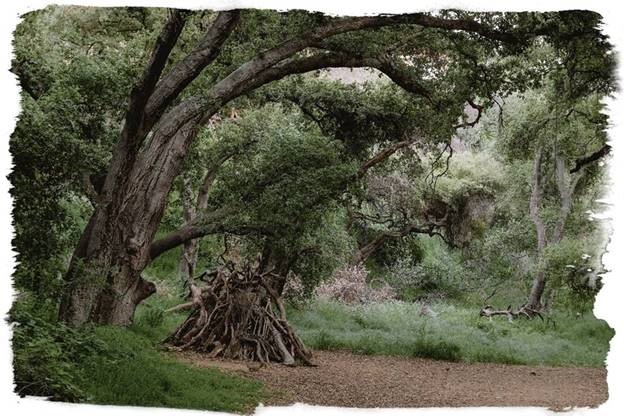
Just as I did this past week looking at a “wood-pile” shelter built in a clearing. Perhaps this shelter was an intentional prayer in itself, one where the builders could return to the gift they provided for others as they need it.

THE SHELTER


clip_image002[4]