THE UNBROKEN WORD

I recently had some discussions on the topic of adventure. When we say the word adventure, we often consider it as an event or activity that might break us out of our normal pattern of life. Whatever that is!

Adventure conjures up feelings of excitement, change, adrenalin, and activities that might be considered outside the norm for us. In many cases, what we once considered an adventurous activity is now part of the norm for us. For example, if you are not used to public speaking, then those first steps in grade school or high school can be considered adventurous. We put ourselves out there for all to see (and criticize) and rely on our skills and wit to get us through it. It often takes courage to even place ourselves in line for an adventure, such as getting on that roller coaster that the kids want to ride, but you really would prefer to avoid.

So adventure firstly requires a commitment and then the second stage, the follow-through. When I review my own life and this topic I often feel that adventure, or trying something new, can become a part of your journey. A willingness to take a risk, push your skill sets, explore where you don’t have a map or a guaranteed outcome all comprise of how the adventure is perceived and understood. So, this willingness can apply to our vocational and family life as well as our spiritual journey.

Rather like a child who often takes their lead in the taste of food from diets served and eaten by parents, we gradually build up a list of food types we are unwilling to try. Even when we know that food is good for us, tastes pleasant and looks great, we still refuse to try it out. This is a learned trait even in a two-year-old. When we add up our places of “don’t go there,” they become a massive list by the time we are adults.
Over time, this creates a list of places where our tastes, likes and dislikes come to govern our approach to the world based on a limited palate. This does not just affect food, relationships, social interaction but also our spiritual journey. We become judgmental on prayer types, worship venues, even who we are willing to socialize it.

This coming week perhaps we can reexamine our taste for adventure. Are we willing to try our a new prayer form? Engage in a new spiritual group? Listen to a new message? All these are signs that we have opened ourselves up to hearing what God is saying to us on the inside. Christ is with us always, but are we open for His next suggested adventure in our spiritual journey?

After all, this adventure may have been sitting there for a long time in our hearts and minds, but somehow we didn’t dare to say Yes to it. Perhaps the time to say Yes instead of No to God’s next adventure is here, all we need to do is answer it.

clip_image002

THE UNBROKEN WORD

Belonging and the Call to Action

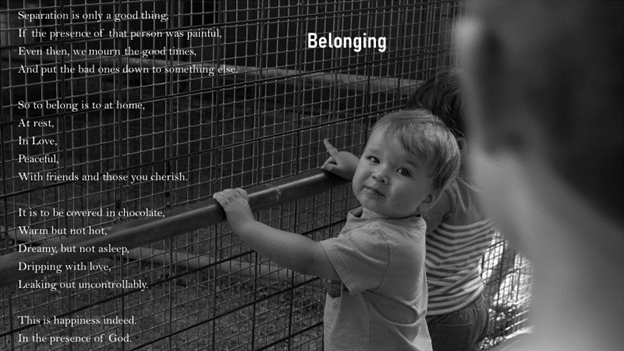
Belonging is a huge topic. It is one studied by historians, psychologists, sociologists, and each and every one of us. While we may not be looking at the tribal character of belonging, or the intrinsic need to “belong” in our lives, we all know about belonging from how it feels.

If we are included, we understand what to be “home” feels like. It is hard to describe, but often that warm feeling we get in our core gives us the assurance that we are loved and attached. This might be very deep, such as in a marriage or family situation, or in the “families” we create in our lives, at work, play and in various groups. Sometimes the relationships with friends and colleagues seem like they go deeper than the ones with our blood relatives; perhaps that has something to do with the ability to chose your friends.

The need for belonging is built into our DNA, we know how important it is to belong, and we can tell the difference between being included and being loved and accepted. The acceptance in any relationship shows our openness to one another. Our ability to be loved is often very much related to our willingness to show love.

Our desire to belong is, therefore, something that binds us all together. Belonging is both a desire and a need. We all want it; otherwise, we would be spending our lives rejecting others, not letting them into the inner circle of our soul, where our heartbeats and where God resides within us. While we all have our moments in rejecting others, sometimes unknowingly, a state of continued rejection is one of exhaustion. It is too much work to spend time being ornery to others, at least all of the time!

So while we want to be on the receiving end of love, acceptance, invitations, and all the “incoming” benefits of belonging, there is more to it than this. To really belong, we have also to take action. We cannot remain inert, sitting there like a sponge waiting for others to invite us to join. Jesus’s mission in teaching had him on the road, explaining, teaching, inviting, disputing and clashing with those who taught hatred and self-promotion, replacing it with the guidelines of loving God and one another in what we now know as the body of Christ. That’s us!

So perhaps this week we can consider those guidelines, clearly delineated in the beatitudes and supported by the Gifts of the Holy Spirit showered on us during Pentecost, we can make the connection ourselves. Are we really using those gifts as well as we could? The Church says, “All are welcome,” am I practicing this in my life? I know for myself, there are always ways where my belonging to a certain group also, in a subtle way, excludes and differentiates me from others. This is not what Jesus intended. Remember what we do to the least of our brothers and sisters, we do to Christ?

If we remember Christ in our belonging, we will be both grateful and mindful in our treatment of others. This is something I will try and keep on my heart.

clip_image002

THE UNBROKEN WORD

Belonging and the Call to Action

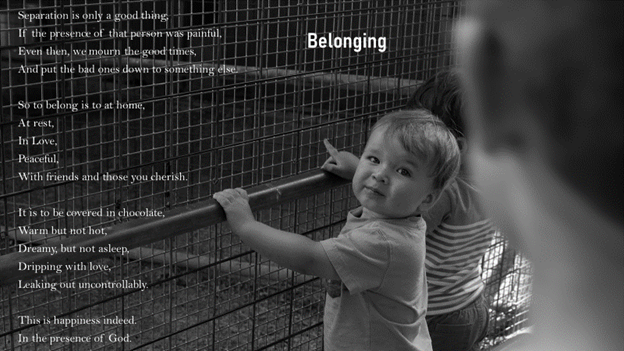
Belonging is a huge topic. It is one studied by historians, psychologists, sociologists, and each and every one of us. While we may not be looking at the tribal character of belonging, or the intrinsic need to “belong” in our lives, we all know about belonging from how it feels.

If we are included, we understand what to be “home” feels like. It is hard to describe, but often that warm feeling we get in our core gives us the assurance that we are loved and attached. This might be very deep, such as in a marriage or family situation, or in the “families” we create in our lives, at work, play and in various groups. Sometimes the relationships with friends and colleagues seem like they go deeper than the ones with our blood relatives; perhaps that has something to do with the ability to chose your friends.

The need for belonging is built into our DNA, we know how important it is to belong, and we can tell the difference between being included and being loved and accepted. The acceptance in any relationship shows our openness to one another. Our ability to be loved is often very much related to our willingness to show love.

Our desire to belong is, therefore, something that binds us all together. Belonging is both a desire and a need. We all want it; otherwise, we would be spending our lives rejecting others, not letting them into the inner circle of our soul, where our heartbeats and where God resides within us. While we all have our moments in rejecting others, sometimes unknowingly, a state of continued rejection is one of exhaustion. It is too much work to spend time being ornery to others, at least all of the time!

So while we want to be on the receiving end of love, acceptance, invitations, and all the “incoming” benefits of belonging, there is more to it than this. To really belong, we have also to take action. We cannot remain inert, sitting there like a sponge waiting for others to invite us to join. Jesus’s mission in teaching had him on the road, explaining, teaching, inviting, disputing and clashing with those who taught hatred and self-promotion, replacing it with the guidelines of loving God and one another in what we now know as the body of Christ. That’s us!

So perhaps this week we can consider those guidelines, clearly delineated in the beatitudes and supported by the Gifts of the Holy Spirit showered on us during Pentecost, we can make the connection ourselves. Are we really using those gifts as well as we could? The Church says, “All are welcome,” am I practicing this in my life? I know for myself, there are always ways where my belonging to a certain group also, in a subtle way, excludes and differentiates me from others. This is not what Jesus intended. Remember what we do to the least of our brothers and sisters, we do to Christ?

If we remember Christ in our belonging, we will be both grateful and mindful in our treatment of others. This is something I will try and keep on my heart.

clip_image002