THE DAILY GOSPEL AND READINGS 6 FEBRUARY 2013

Memorial of Saint Paul Miki and Companions, Martyrs
Lectionary: 325

Reading 1 Heb 12:4-7, 11-15

Brothers and sisters:
In your struggle against sin
you have not yet resisted to the point of shedding blood.
You have also forgotten the exhortation addressed to you as children:
My son, do not disdain the discipline of the Lord
or lose heart when reproved by him;
for whom the Lord loves, he disciplines;
he scourges every son he acknowledges.

Endure your trials as “discipline”;
God treats you as his sons.
For what Ason” is there whom his father does not discipline?
At the time, all discipline seems a cause not for joy but for pain,
yet later it brings the peaceful fruit of righteousness
to those who are trained by it.
So strengthen your drooping hands and your weak knees.
Make straight paths for your feet,
that what is lame may not be dislocated but healed.
Strive for peace with everyone,
and for that holiness without which no one will see the Lord.
See to it that no one be deprived of the grace of God,
that no bitter root spring up and cause trouble,
through which many may become defiled.

Responsorial Psalm Ps 103:1-2, 13-14, 17-18a

R. (see 17) The Lord’s kindness is everlasting to those who fear him.
Bless the LORD, O my soul;
and all my being, bless his holy name.
Bless the LORD, O my soul,
and forget not all his benefits.
R. The Lord’s kindness is everlasting to those who fear him.
As a father has compassion on his children,
so the LORD has compassion on those who fear him,
For he knows how we are formed;
he remembers that we are dust.
R. The Lord’s kindness is everlasting to those who fear him.
But the kindness of the LORD is from eternity
to eternity toward those who fear him,
And his justice toward children’s children
among those who keep his covenant.
R. The Lord’s kindness is everlasting to those who fear him.

Gospel Mk 6:1-6

Jesus departed from there and came to his native place, accompanied by his disciples.
When the sabbath came he began to teach in the synagogue,
and many who heard him were astonished.
They said, “Where did this man get all this?
What kind of wisdom has been given him?
What mighty deeds are wrought by his hands!
Is he not the carpenter, the son of Mary,
and the brother of James and Joseph and Judas and Simon?
And are not his sisters here with us?”
And they took offense at him.
Jesus said to them,
“A prophet is not without honor except in his native place
and among his own kin and in his own house.”
So he was not able to perform any mighty deed there,
apart from curing a few sick people by laying his hands on them.
He was amazed at their lack of faith.

Lectionary for Mass for Use in the Dioceses of the United States, second typical edition, Copyright © 2001, 1998, 1997, 1986, 1970 Confraternity of Christian Doctrine; Psalm refrain © 1968, 1981, 1997, International Committee on English in the Liturgy, Inc. All rights reserved. Neither this work nor any part of it may be reproduced, distributed, performed or displayed in any medium, including electronic or digital, without permission in writing from the copyright owner.
THE DAILY GOSPEL AND READINGS 5 JANUARY 2013

Memorial of Saint John Neumann, Bishop
Lectionary: 208

Reading 1 1 Jn 3:11-21

Beloved:
This is the message you have heard from the beginning:
we should love one another,
unlike Cain who belonged to the Evil One
and slaughtered his brother.
Why did he slaughter him?
Because his own works were evil,
and those of his brother righteous.
Do not be amazed, then, brothers and sisters, if the world hates you.
We know that we have passed from death to life
because we love our brothers.
Whoever does not love remains in death.
Everyone who hates his brother is a murderer,
and you know that no murderer has eternal life remaining in him.
The way we came to know love
was that he laid down his life for us;
so we ought to lay down our lives for our brothers.
If someone who has worldly means
sees a brother in need and refuses him compassion,
how can the love of God remain in him?
Children, let us love not in word or speech
but in deed and truth.
Now this is how we shall know that we belong to the truth
and reassure our hearts before him
in whatever our hearts condemn,
for God is greater than our hearts and knows everything.
Beloved, if our hearts do not condemn us,
we have confidence in God.

Responsorial Psalm Ps 100:1b-2, 3, 4, 5

R. (2a) Let all the earth cry out to God with joy.
Sing joyfully to the LORD, all you lands;
serve the LORD with gladness;
come before him with joyful song.
R. Let all the earth cry out to God with joy.
Know that the LORD is God;
he made us, his we are;
his people, the flock he tends.
R. Let all the earth cry out to God with joy.
Enter his gates with thanksgiving,
his courts with praise;
Give thanks to him; bless his name.
R. Let all the earth cry out to God with joy.
The LORD is good:
the LORD, whose kindness endures forever,
and his faithfulness, to all generations.
R. Let all the earth cry out to God with joy.

Gospel Jn 1:43-51

Jesus decided to go to Galilee, and he found Philip.
And Jesus said to him, “Follow me.”
Now Philip was from Bethsaida, the town of Andrew and Peter.
Philip found Nathanael and told him,
“We have found the one about whom Moses wrote in the law,
and also the prophets, Jesus, son of Joseph, from Nazareth.”
But Nathanael said to him,
“Can anything good come from Nazareth?”
Philip said to him, “Come and see.”
Jesus saw Nathanael coming toward him and said of him,
“Here is a true child of Israel.
There is no duplicity in him.”
Nathanael said to him, “How do you know me?”
Jesus answered and said to him,
“Before Philip called you, I saw you under the fig tree.”
Nathanael answered him,
“Rabbi, you are the Son of God; you are the King of Israel.”
Jesus answered and said to him,
“Do you believe
because I told you that I saw you under the fig tree?
You will see greater things than this.”
And he said to him, “Amen, amen, I say to you,
you will see the sky opened and the angels of God
ascending and descending on the Son of Man.”

Lectionary for Mass for Use in the Dioceses of the United States, second typical edition, Copyright © 2001, 1998, 1997, 1986, 1970 Confraternity of Christian Doctrine; Psalm refrain © 1968, 1981, 1997, International Committee on English in the Liturgy, Inc. All rights reserved. Neither this work nor any part of it may be reproduced, distributed, performed or displayed in any medium, including electronic or digital, without permission in writing from the copyright owner.

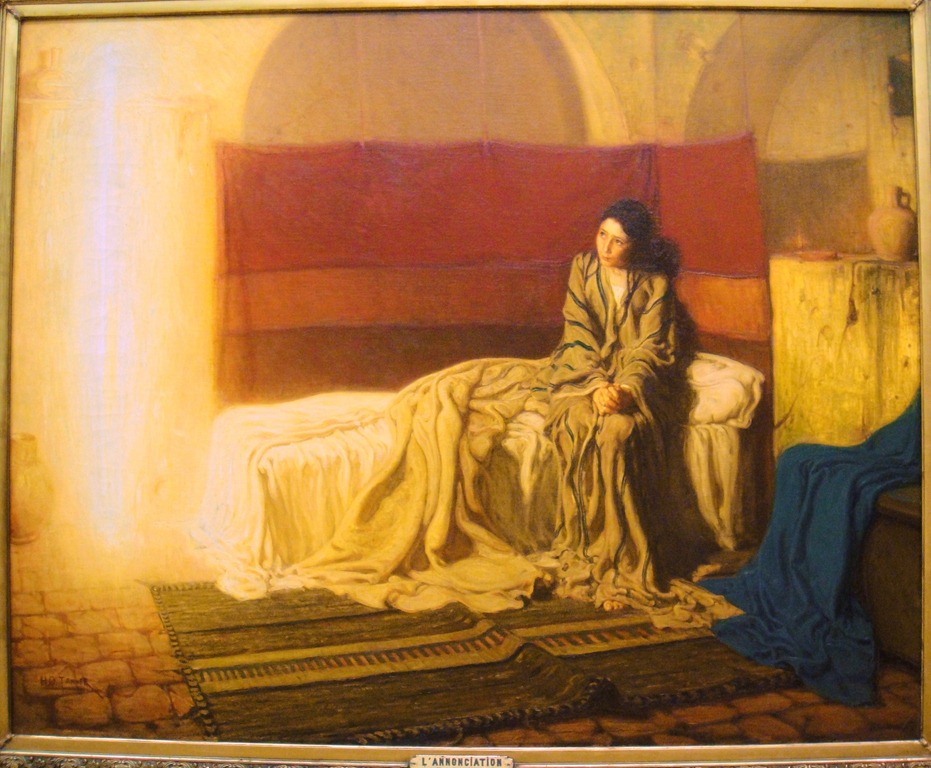
POEM and IMAGE ON THE ANNUNCIATION

henry-ossawa-tanner-the-annunciation 

Painting by Henry Tanner

Annunciation

by Denise Levertov

‘Hail, space for the uncontained God’
From the Agathistos Hymn, Greece, VIc

We know the scene: the room, variously furnished,
almost always a lectern, a book; always
the tall lily.
Arrived on solemn grandeur of great wings,
the angelic ambassador, standing or hovering,
whom she acknowledges, a guest.

But we are told of meek obedience. No one mentions
courage.
The engendering Spirit
did not enter her without consent.
God waited.

She was free
to accept or to refuse, choice
integral to humanness.
Aren’t there annunciations
of one sort or another
in most lives?
Some unwillingly
undertake great destinies,
enact them in sullen pride,
uncomprehending.
More often
those moments
when roads of light and storm
open from darkness in a man or woman,
are turned away from
in dread, in a wave of weakness, in despair
and with relief.

Ordinary lives continue.
God does not smite them.
But the gates close, the pathway vanishes.

She had been a child who played, ate, slept
like any other child – but unlike others,
wept only for pity, laughed
in joy not triumph.
Compassion and intelligence
fused in her, indivisible.

Called to a destiny more momentous
than any in all of Time,
she did not quail,
only asked
a simple, ‘How can this be?’
and gravely, courteously,
took to heart the angel’s reply,
perceiving instantly
the astounding ministry she was offered:

to bear in her womb
Infinite weight and lightness; to carry
in hidden, finite inwardness,
nine months of Eternity; to contain
in slender vase of being,
the sum of power –
in narrow flesh,
the sum of light.
Then bring to birth,
push out into air, a Man-child
needing, like any other,
milk and love –
but who was God.

There was the minute no one speaks of,

When she could still refuse.

A breath unbreathed,
Spirit,
suspended,
waiting.

She did not cry, “I cannot, I am not worthy.”
nor, “I have not strength.”
She did not submit with gritted teeth,
raging, coerced.
Bravest of all humans,
consent illumined her.
The room filled with its light,
the lily glowed in it,
and the iridescent wings.
Consent,
courage unparalleled,
opened her utterly.

From: The Stream & the Sapphire: Selected Poems on Religious Themes

(New York: New Directions Books, 1997) pp. 59-61