THE DAILY GOSPEL AND READINGS 16 AUGUST 2013

Twentieth Sunday in Ordinary Time
Lectionary: 120

Reading 1 Jer 38:4-6, 8-10

In those days, the princes said to the king:
“Jeremiah ought to be put to death;
he is demoralizing the soldiers who are left in this city,
and all the people, by speaking such things to them;
he is not interested in the welfare of our people,
but in their ruin.”
King Zedekiah answered: “He is in your power”;
for the king could do nothing with them.
And so they took Jeremiah
and threw him into the cistern of Prince Malchiah,
which was in the quarters of the guard,
letting him down with ropes.
There was no water in the cistern, only mud,
and Jeremiah sank into the mud.
Ebed-melech, a court official,
went there from the palace and said to him:
“My lord king,
these men have been at fault
in all they have done to the prophet Jeremiah,
casting him into the cistern.
He will die of famine on the spot,
for there is no more food in the city.”
Then the king ordered Ebed-melech the Cushite
to take three men along with him,
and draw the prophet Jeremiah out of the cistern before
he should die.

Responsorial Psalm Ps 40:2, 3, 4, 18

R. (14b) Lord, come to my aid!
I have waited, waited for the LORD,
and he stooped toward me.
R. Lord, come to my aid!
The LORD heard my cry.
He drew me out of the pit of destruction,
out of the mud of the swamp;
he set my feet upon a crag;
he made firm my steps.
R. Lord, come to my aid!
And he put a new song into my mouth,
a hymn to our God.
Many shall look on in awe
and trust in the LORD.
R. Lord, come to my aid!
Though I am afflicted and poor,
yet the LORD thinks of me.
You are my help and my deliverer;
O my God, hold not back!
R. Lord, come to my aid!

Reading 2 Heb 12:1-4

Brothers and sisters:
Since we are surrounded by so great a cloud of witnesses,
let us rid ourselves of every burden and sin that clings to us
and persevere in running the race that lies before us
while keeping our eyes fixed on Jesus,
the leader and perfecter of faith.
For the sake of the joy that lay before him
he endured the cross, despising its shame,
and has taken his seat at the right of the throne of God.
Consider how he endured such opposition from sinners,
in order that you may not grow weary and lose heart.
In your struggle against sin
you have not yet resisted to the point of shedding blood.

Gospel Lk 12:49-53

Jesus said to his disciples:
“I have come to set the earth on fire,
and how I wish it were already blazing!
There is a baptism with which I must be baptized,
and how great is my anguish until it is accomplished!
Do you think that I have come to establish peace on the earth?
No, I tell you, but rather division.
From now on a household of five will be divided,
three against two and two against three;
a father will be divided against his son
and a son against his father,
a mother against her daughter
and a daughter against her mother,
a mother-in-law against her daughter-in-law
and a daughter-in-law against her mother-in-law.”

Lectionary for Mass for Use in the Dioceses of the United States, second typical edition, Copyright © 2001, 1998, 1997, 1986, 1970 Confraternity of Christian Doctrine; Psalm refrain © 1968, 1981, 1997, International Committee on English in the Liturgy, Inc. All rights reserved. Neither this work nor any part of it may be reproduced, distributed, performed or displayed in any medium, including electronic or digital, without permission in writing from the copyright owner.
THE DAILY GOSPEL AND READINGS 29 JANUARY 2013

Tuesday of the Third Week in Ordinary Time
Lectionary: 318

Reading 1 Heb 10:1-10

Brothers and sisters:
Since the law has only a shadow of the good things to come,
and not the very image of them, it can never make perfect
those who come to worship by the same sacrifices
that they offer continually each year.
Otherwise, would not the sacrifices have ceased to be offered,
since the worshipers, once cleansed, would no longer
have had any consciousness of sins?
But in those sacrifices there is only a yearly remembrance of sins,
for it is impossible that the blood of bulls and goats
take away sins.
For this reason, when he came into the world, he said:
Sacrifice and offering you did not desire,
but a body you prepared for me;
in burnt offerings and sin offerings you took no delight.
Then I said, As is written of me in the scroll,
Behold, I come to do your will, O God.

First he says, Sacrifices and offerings,
burnt offerings and sin offerings,
you neither desired nor delighted in.

These are offered according to the law.
Then he says, Behold, I come to do your will.
He takes away the first to establish the second.
By this “will,” we have been consecrated
through the offering of the Body of Jesus Christ once for all.

Responsorial Psalm ps 40:2 and 4ab, 7-8a, 10, 11

R. (8a and 9a) Here am I Lord; I come to do your will.
I have waited, waited for the LORD,
and he stooped toward me.
And he put a new song into my mouth,
a hymn to our God.
R. Here am I Lord; I come to do your will.
Sacrifice or oblation you wished not,
but ears open to obedience you gave me.
Burnt offerings or sin-offerings you sought not;
then said I, “Behold I come.”
R. Here am I Lord; I come to do your will.
I announced your justice in the vast assembly;
I did not restrain my lips, as you, O LORD, know.
R. Here am I Lord; I come to do your will.
Your justice I kept not hid within my heart;
your faithfulness and your salvation I have spoken of;
I have made no secret of your kindness and your truth
in the vast assembly.
R. Here am I Lord; I come to do your will.

Gospel Mk 3:31-35

The mother of Jesus and his brothers arrived at the house.
Standing outside, they sent word to Jesus and called him.
A crowd seated around him told him,
“Your mother and your brothers and your sisters
are outside asking for you.”
But he said to them in reply,
“Who are my mother and my brothers?”
And looking around at those seated in the circle he said,
“Here are my mother and my brothers.
For whoever does the will of God
is my brother and sister and mother.”

Lectionary for Mass for Use in the Dioceses of the United States, second typical edition, Copyright © 2001, 1998, 1997, 1986, 1970 Confraternity of Christian Doctrine; Psalm refrain © 1968, 1981, 1997, International Committee on English in the Liturgy, Inc. All rights reserved. Neither this work nor any part of it may be reproduced, distributed, performed or displayed in any medium, including electronic or digital, without permission in writing from the copyright owner.

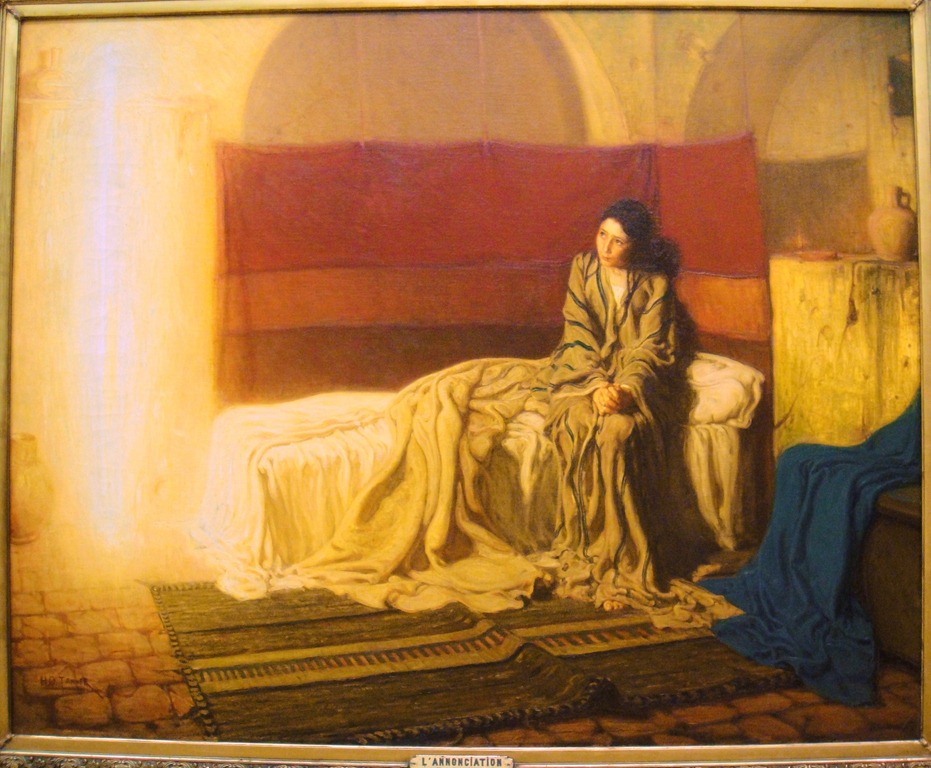
POEM and IMAGE ON THE ANNUNCIATION

henry-ossawa-tanner-the-annunciation 

Painting by Henry Tanner

Annunciation

by Denise Levertov

‘Hail, space for the uncontained God’
From the Agathistos Hymn, Greece, VIc

We know the scene: the room, variously furnished,
almost always a lectern, a book; always
the tall lily.
Arrived on solemn grandeur of great wings,
the angelic ambassador, standing or hovering,
whom she acknowledges, a guest.

But we are told of meek obedience. No one mentions
courage.
The engendering Spirit
did not enter her without consent.
God waited.

She was free
to accept or to refuse, choice
integral to humanness.
Aren’t there annunciations
of one sort or another
in most lives?
Some unwillingly
undertake great destinies,
enact them in sullen pride,
uncomprehending.
More often
those moments
when roads of light and storm
open from darkness in a man or woman,
are turned away from
in dread, in a wave of weakness, in despair
and with relief.

Ordinary lives continue.
God does not smite them.
But the gates close, the pathway vanishes.

She had been a child who played, ate, slept
like any other child – but unlike others,
wept only for pity, laughed
in joy not triumph.
Compassion and intelligence
fused in her, indivisible.

Called to a destiny more momentous
than any in all of Time,
she did not quail,
only asked
a simple, ‘How can this be?’
and gravely, courteously,
took to heart the angel’s reply,
perceiving instantly
the astounding ministry she was offered:

to bear in her womb
Infinite weight and lightness; to carry
in hidden, finite inwardness,
nine months of Eternity; to contain
in slender vase of being,
the sum of power –
in narrow flesh,
the sum of light.
Then bring to birth,
push out into air, a Man-child
needing, like any other,
milk and love –
but who was God.

There was the minute no one speaks of,

When she could still refuse.

A breath unbreathed,
Spirit,
suspended,
waiting.

She did not cry, “I cannot, I am not worthy.”
nor, “I have not strength.”
She did not submit with gritted teeth,
raging, coerced.
Bravest of all humans,
consent illumined her.
The room filled with its light,
the lily glowed in it,
and the iridescent wings.
Consent,
courage unparalleled,
opened her utterly.

From: The Stream & the Sapphire: Selected Poems on Religious Themes

(New York: New Directions Books, 1997) pp. 59-61