THE DAILY GOSPEL AND READINGS 16 FEBRUARY 2013

Saturday after Ash Wednesday
Lectionary: 222

Reading 1 Is 58:9b-14

Thus says the LORD:
If you remove from your midst oppression,
false accusation and malicious speech;
If you bestow your bread on the hungry
and satisfy the afflicted;
Then light shall rise for you in the darkness,
and the gloom shall become for you like midday;
Then the LORD will guide you always
and give you plenty even on the parched land.
He will renew your strength,
and you shall be like a watered garden,
like a spring whose water never fails.
The ancient ruins shall be rebuilt for your sake,
and the foundations from ages past you shall raise up;
“Repairer of the breach,” they shall call you,
“Restorer of ruined homesteads.”
If you hold back your foot on the sabbath
from following your own pursuits on my holy day;
If you call the sabbath a delight,
and the LORD’s holy day honorable;
If you honor it by not following your ways,
seeking your own interests, or speaking with malice–
Then you shall delight in the LORD,
and I will make you ride on the heights of the earth;
I will nourish you with the heritage of Jacob, your father,
for the mouth of the LORD has spoken.

Responsorial Psalm Ps 86:1-2, 3-4, 5-6

R. (11ab) Teach me your way, O Lord, that I may walk in your truth.
Incline your ear, O LORD; answer me,
for I am afflicted and poor.
Keep my life, for I am devoted to you;
save your servant who trusts in you.
You are my God.
R. Teach me your way, O Lord, that I may walk in your truth.
Have mercy on me, O Lord,
for to you I call all the day.
Gladden the soul of your servant,
for to you, O Lord, I lift up my soul.
R. Teach me your way, O Lord, that I may walk in your truth.
For you, O Lord, are good and forgiving,
abounding in kindness to all who call upon you.
Hearken, O LORD, to my prayer
and attend to the sound of my pleading.
R. Teach me your way, O Lord, that I may walk in your truth.

Gospel Lk 5:27-32

Jesus saw a tax collector named Levi sitting at the customs post.
He said to him, “Follow me.”
And leaving everything behind, he got up and followed him.
Then Levi gave a great banquet for him in his house,
and a large crowd of tax collectors
and others were at table with them.
The Pharisees and their scribes complained to his disciples, saying,
“Why do you eat and drink with tax collectors and sinners?”
Jesus said to them in reply,
“Those who are healthy do not need a physician, but the sick do.
I have not come to call the righteous to repentance but sinners.”

Lectionary for Mass for Use in the Dioceses of the United States, second typical edition, Copyright © 2001, 1998, 1997, 1986, 1970 Confraternity of Christian Doctrine; Psalm refrain © 1968, 1981, 1997, International Committee on English in the Liturgy, Inc. All rights reserved. Neither this work nor any part of it may be reproduced, distributed, performed or displayed in any medium, including electronic or digital, without permission in writing from the copyright owner.
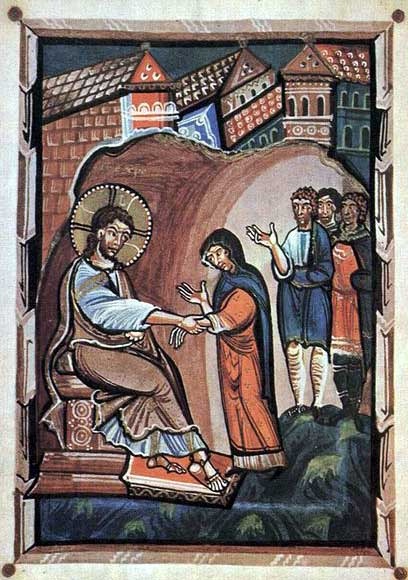
REFLECTION ON JESUS HEALING THE MAN WITH THE WITHERED HAND 23 JANUARY 2013


MAN WITH WITHERED HAND

Jesus shows us that sometimes our good deeds will result in our persecution. Those that judge (in this case the Pharisees), will ultimately be judged themselves. So we have to try and live out our Christian life as much as possible, and rely God to respond to us generously to our faith. By showing his power on the Sabbath, Jesus added to the list of reasons why the Pharisees wanted to “get rid of him”.
He clearly differentiated, through this miracle, who He was and his ability to heal and forgive sin. 

THE DAILY GOSPEL AND READINGS 23 JANUARY 2013

Wednesday of the Second Week in Ordinary Time
Lectionary: 313

Reading 1 Heb 7:1-3, 15-17

Melchizedek, king of Salem and priest of God Most High,
met Abraham as he returned from his defeat of the kings
and blessed him.
And Abraham apportioned to him a tenth of everything.
His name first means righteous king,
and he was also “king of Salem,” that is, king of peace.
Without father, mother, or ancestry,
without beginning of days or end of life,
thus made to resemble the Son of God, he remains a priest forever.
It is even more obvious if another priest is raised up
after the likeness of Melchizedek, who has become so,
not by a law expressed in a commandment concerning physical descent
but by the power of a life that cannot be destroyed.
For it is testified:
You are a priest forever according to the order of Melchizedek.

Responsorial Psalm ps 110:1, 2, 3, 4

R. (4b) You are a priest for ever, in the line of Melchizedek.
The LORD said to my Lord: “Sit at my right hand
till I make your enemies your footstool.”
R. You are a priest for ever, in the line of Melchizedek.
The scepter of your power the LORD will stretch forth from Zion:
“Rule in the midst of your enemies.”
R. You are a priest for ever, in the line of Melchizedek.
“Yours is princely power in the day of your birth, in holy splendor;
before the daystar, like the dew, I have begotten you.”
R. You are a priest for ever, in the line of Melchizedek.
The LORD has sworn, and he will not repent:
“You are a priest forever, according to the order of Melchizedek.”
R. You are a priest for ever, in the line of Melchizedek.

Gospel Mk 3:1-6

Jesus entered the synagogue.
There was a man there who had a withered hand.
They watched Jesus closely
to see if he would cure him on the sabbath
so that they might accuse him.
He said to the man with the withered hand,
“Come up here before us.”
Then he said to the Pharisees,
“Is it lawful to do good on the sabbath rather than to do evil,
to save life rather than to destroy it?”
But they remained silent.
Looking around at them with anger
and grieved at their hardness of heart,
Jesus said to the man, “Stretch out your hand.”
He stretched it out and his hand was restored.
The Pharisees went out and immediately took counsel
with the Herodians against him to put him to death.

Lectionary for Mass for Use in the Dioceses of the United States, second typical edition, Copyright © 2001, 1998, 1997, 1986, 1970 Confraternity of Christian Doctrine; Psalm refrain © 1968, 1981, 1997, International Committee on English in the Liturgy, Inc. All rights reserved. Neither this work nor any part of it may be reproduced, distributed, performed or displayed in any medium, including electronic or digital, without permission in writing from the copyright owner.