THE UNBROKEN WORD

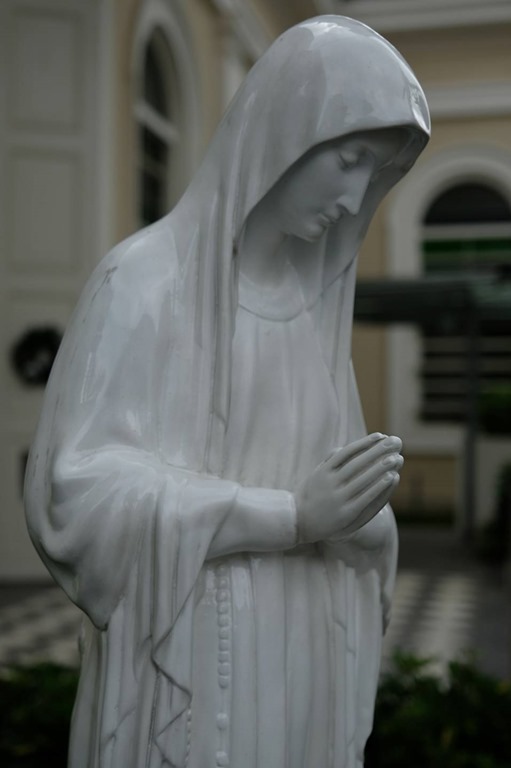
We have all returned to those times as a child when all seemed simpler and easier. While this may not be true of all childhoods, I can certainly return to mine and see it was a time that had less distractions than my teenage years.

As someone who has been involved in ministry with children and owning four of my own, and through the grace of God, nine grandchildren, I often look at things through their lens. While there are benefits of being childlike, there are also complications.

You have to follow the guidelines/rules or others; life is fairly structured without much “downtime” included, and of course, we are ALWAYS relying on someone else to get us where we need to go. However, when I look back on my faith life, there was much to be pleased about a child. While I learned about my faith through the strict governance of the Dominican nuns at my elementary school, and an Irish priest who dispensed his own special form of ministry; I was, for the most part, surrounded by love. It was love with strings attached for sure, but it was love. They cared for me, and even more for my soul. I can still hear the words “ for what does it matter if you suffer the loss of your soul …”

This lament, even though I didn’t really know what it meant, did start me out on a journey as a child. A journey to discover this invisible but important part of me, my soul!

I wonder what your experience of this inner search for your soul, its content, character, how it looked affected your faith? How does it affect your faith today? Have you come to terms with what your soul is today? How would you describe its condition? Excellent? Slightly used? Low mileage? Never been wrecked?

Taking a journey back to those early days may help you find some answers. After all we use the words “soul-searching” often. But what does it really mean to us?

This week is a time for some gentle soul-searching. God Bless.

Earlier Times

clip_image002

THE UNBROKEN WORD

Retelling Our Own Story
When we look carefully to see how God is working in us today, we invariably look to the past for guidance. What did we learn from this experience? Did the suffering help me or alienate me from God? Have I been grateful for the good things in my life?

All of these questions and their answers tell a story which is “our story.” However, sometimes that story is given to us by another and we often do one of two things with it. Firstly, we can accept the story or lesson as given to us by another; perhaps a parent or a friend tells us our own story and what they think we should have learned from it. Or secondly, we can refuse to accept our version of the story and instead play a “what if” game to see how our life might have turned out differently.

In the first case, we may find that someone else is defining our own lives and how we should react to an event based on what they tell us is our story. The dangers of accepting this approach can be obvious, someone tells us we are a failure because of one failure, we lose one battle and therefore, we are always a loser. You get the idea.

The second case is something which also affects many of us, what would have happened if I met this person earlier in my life, married a different person, had another career. We play the “what if” game trying to relive a life that didn’t happen. We only have what did happen to work with and how we interpret its meaning or direction.

When we look today for what God is Doing In Us, we can take another approach in reviewing the past. That is to “retell” our story. In retelling our own story, we don’t change the facts of course, but we can change what we learn from them. For example, telling my own story of self-reliance during my teen years, and how it changed my spiritual disposition, introducing some “lean years” in my relationship with God has had a surprising benefit.
In telling this story first to myself, I saw how I caused myself to induce some distance between God and me. Or at least that is what I thought. However in retelling this story and sharing it with others, it became obvious this was just a movement in my overall spiritual journey; a waypoint if you like, not a final destination.

We can also find our own story is retold by listening to others, their experiences can resonate with our own, giving us pointers to how God is “really” working in us all the time, even when we feel remote and distant.

Our willingness to retell a story, particularly our own story, requires an honesty that keeps the door open, and our heart opens to hear what is really going on. A closed mind precedes a closed heart, an unwillingness to listen, to receive the grace which is often waiting to be poured out.

Let us let the grace pour out this week by examining some of our own stories, and see where God has been working in us all the time. Just as the disciples the road to Emmaus, we just didn’t recognize Him.

clip_image002
My Footprints 


They have been smaller,
And tentative at times.
Tiptoeing,
Stamping,
And held their ground on occasions.


But always, they have included You,
Even if I wanted to head in a particular direction for a while,
They returned to a Compass Rose,
Correcting what needed to change.


At least when I listened for Your voice.


Reflection, Photograph and Poem Copyright 2020 Michael J. Cunningham OFS

THE UNBROKEN WORD

Prayer as Belonging

The desire to belong is something where both secular and spiritual experts can agree, is built into all of us. It is not a characteristic we can turn on or off based on our needs, although we may think we can control it. Most forms of belonging, at least in the true sense, are based in love. Our need to belong to a family, a loved one, or a group where there is affinity.

Belonging is also instinctive. We have a need to belong to someone; our mother, father, siblings, friends all make us naturally migrate towards each other. We can often identify this need for belonging when we are separated from the others; when we are rejected, repelled, or disinvited to be a part of the group. It’s as if the pain of separation reinforces the need to belong.

Perhaps there is little that broadcasts the scriptural commands from the New Testament more than the need for belonging. In John 13:34-35, just before his passion and death on the Cross, Jesus raised belonging to the ultimate level:

“I give you a new commandment, that you love one another. Just as I have loved you, you also should love one another. By this everyone will know that you are my disciples, if you have love for one another.

This commandment reinforces what is already a part of our essence, we are The Body of Christ. Where God resides in us, so does our Holy Longing for God’s love and thereby our love for each other. And yet, we still use this power to allow others to “belong” to groups in our lives; to restrict or exclude them. Each time we are unwelcoming or reject others, we exercise our gift of belonging which is within us all. So it is a gift we can use to accept or reject others; by either giving or restricting. To exercise judgment for good or bad.

This week, we can reflect on some times and places in our lives where we are using belonging as it was meant to be. As an invitation to the dialog, as welcoming, as the returning Prodigal Son, or as the Father who invited the son home. Take a look and see how belonging shows how God is operating within us, even when we seem to be unaware.

Where we have failed, and we all have at some point, we can, of course, pray for belonging. That we may be accepting of others, and that others may accept us. Why, because He is Always With Us (Mt 28:20) and we with Him.

clip_image002

A Prayer of Belonging

Dear Lord,

Let me belong.

Let me belong to you.

Let me belong to a community.

Let me belong to a family.

Let me belong.


In the daylight, let me belong.

At night, let me belong.

During times of illness and strife, let me belong.

During good times, let me belong.

But always, let me belong to you.


For it is your belonging where all belonging begins;

And does not end.


In this I pray. Amen.